Pre-alpha Coming to Steam

Southern Spear: An Australian‑inspired tactical multiplayer experience.

Built around teamwork, training, communication and objective‑focused infantry combat.

Scroll

In the engine

What it looks like today


Straight from the pre‑alpha build, no mock‑ups: Unreal Engine 5.8, the A25 in a first‑person hold, the red‑earth country of Red Gum, and the new HUD. Work in progress, captured 6 October 2026.

A short looping clip from first person: the A88 fires across a red-earth clearing, with muzzle flash and a tracer, and the ammunition count falling.
Firing the A88 — a short loop from the build, no audio.
  • A new HUD: compass, minimap, objectives, squad roster and ammunition
  • Recoil and zero derived from the cartridge, mass and published data
  • Seven maps at different stages, two of them in the game
More captures

Overview

A tactical shooter built in the open

Southern Spear is a first-person tactical shooter in the tradition of classic team‑based military shooters: realistic pacing, small teams, clear roles, and objectives that only fall to coordinated play. It is set in a fictional world inspired by Australia.

Its design philosophy is inspired by the classic America’s Army games — deliberate infantry combat, low time‑to‑kill, a deliberately limited HUD, strong communication and role discipline, and mandatory training before a specialised role opens up.

You fight across outback stations, dry creek lines and red‑earth country as a soldier of the fictional 3rd Battalion, Australian Commonwealth Regiment (3 ACR). Matches are Objective Assault: two teams fight over a chain of objectives that fall in order, round after round.

There are no loot boxes, no pay‑to‑win and no hero classes. Every weapon and every character is mechanically identical on both sides — only how they look changes, and only to the viewer.

Status
Pre‑alpha — in active development
Engine
Unreal Engine 5.8
Foundation
Lyra Starter Game
Platform
Coming to Steam
Mode
Objective Assault
Price
Free
Public build
None yet
Inspiration
Classic America’s Army design philosophy

Inspired by, not affiliated with. Southern Spear takes its design philosophy from the classic America’s Army games. It is an entirely original work: no source code, map layout, mission name, interface, audio, dialogue or artwork is copied or reused. It is not affiliated with, endorsed by, sponsored by or approved by America’s Army or the United States Army, and it borrows none of their marks, names or insignia.

A fictional entertainment project. Southern Spear is not endorsed, sponsored, developed or approved by the Australian Government, the Department of Defence, the Australian Defence Force or the Australian Army. All organisations, units, forces and weapons are fictional, and no map reproduces a real base, installation or operationally useful site.

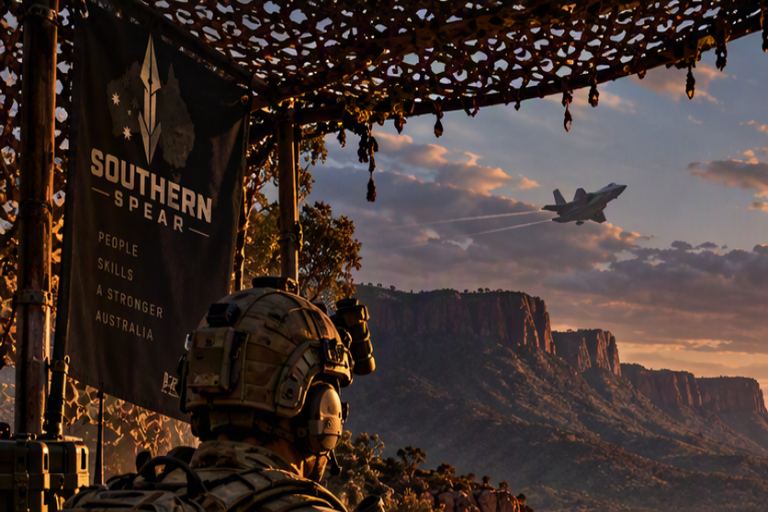
Title‑screen artwork detail: a soldier in camouflage overlooking a wide red-earth valley and a dry creek line at sunset.
Concept art Detail from the title‑screen artwork. Not captured gameplay.

Systems

Four pillars of the design

These are the intended systems from the project's design documents. They are what the roadmap is building towards, not features that exist in a playable build today.

Train

Training is a core progression system, not a tutorial. It is replayable, stores your best results, and unlocks multiplayer roles.

  • Five graded modules, from Induction to Leadership
  • Scored weapons and support‑weapon qualifications
  • Field skills, including medic and identification training
  • Leadership strictly gated behind prerequisites

Operate

Objectives are taken by holding the ring. Opposing soldiers inside contest it, so the fight comes to you.

  • Objective Assault — sequential objectives, round lifecycle
  • Secure and Hold — capture and hold, ticket scoring
  • Radio procedure and tactical communication as first-class systems
  • Role‑based sections with data‑driven limits

Progress

Six separate concepts, kept apart on purpose. That separation is what stops progression collapsing into a kill counter.

  • Service record and a displayed service rank
  • Role and per‑weapon qualifications as binary unlocks
  • Named commendations for specific achievements
  • Rewards for objectives, teamwork, revives and conduct — not for kill ratio

Adapt

Every map ships as data, not code. A layer bundles mode, time of day, weather, objectives, deployment, roles, respawn model and ticket allocation.

  • Seven original maps, at seven different stages, and measured against their own design rules
  • Objective Assault, Secure and Hold, Day and low‑light layers per map
  • Configurable modes without recompiling
  • Accessibility and settings available throughout

Train

Training and qualification framework

Five modules, each granting specific roles. Leadership cannot be reached by skill alone in a firing range, and a qualification you have earned is never invalidated by a server being down.

  1. Induction

    Grants basic rifleman access

    Movement, interaction, HUD, stance, communication and rules of engagement.

  2. Weapons Qualification

    Grants Automatic Rifleman, Marksman

    Familiarisation, controlled pairs, supported firing, reloading and fire‑mode selection. Scored.

  3. Support Weapons Qualification

    Grants Section Support Gunner

    Bipod handling, deployment, suppression and ammunition management. Scored.

  4. Field Skills

    Grants Medic

    Navigation, observation, friendly and opposing identification, objective interaction and basic medical treatment.

  5. Leadership Qualification

    Grants Fireteam Leader, Section Commander

    Fireteam command, waypoint and order placement, radio procedure and objective planning.

Role prerequisites

Rifleman and Grenadier are open after Induction. Support Gunner, Marksman and Medic are limited to two per section. Fireteam Leaders and Section Commanders are limited to one per fireteam and section.

Read silhouettes, not colours

Identification training is explicit, because contextual appearance is only safe if players are trained to read silhouettes and insignia rather than colour.

Stated failure conditions

Failure conditions are stated clearly before an exercise starts, and accessibility options are available throughout.

Operate

One match, two perspectives

Both teams are mechanically identical. Only the presentation differs, and only per viewer.

How you see your own team

3rd Battalion, Australian Commonwealth Regiment

Conventional infantry of the fictional Commonwealth Land Service.

Primary weapon
A88 Standard Service Rifle
Uniform
CMECU
Organisation
Commonwealth Defence Service

How you see the opposing team

Murasian Armed Forces

A fictional, competent conventional army with original red‑earth camouflage, insignia and equipment.

Balance
Mechanically equivalent weapons
Characters
Identical gameplay hitboxes
Difference
Cosmetic, per viewer only

The swap is decided on each player’s own machine and never touches gameplay: damage, movement and hitboxes are the same for everyone. All units and forces are fictional.

Objective Assault

Sequential or parallel objectives; attackers take, defenders hold; limited respawns or round‑based elimination.

Secure and Hold

Capture and hold tactical locations, with ticket or round‑based scoring.

Loadout

The weapons of the current build

Every image here is the weapon model running in the engine, lit by the game’s own sky, with its real textures, optic and magazine. Muzzle speeds are the design figures behind each weapon’s bullet path and recoil, taken from published data for the cartridge.

  • A88 Standard Service Rifle

    Standard-issue bullpup, the weapon the infantry qualifications centre on.

    Unlocks
    Automatic Rifleman, Marksman
    Muzzle speed
    930 m/s
    Zero
    300 m
  • A88G Grenadier Rifle

    The A88 with an underbarrel grenade launcher, and its own hold and reload.

    Role
    Grenadier
    Muzzle speed
    930 m/s
    Zero
    300 m
  • A89 Light Support Weapon

    Bipod-carried support gun for suppression by section.

    Unlocks
    Section Support Gunner
    Handling
    Bipod deployment
    Muzzle speed
    915 m/s
  • A4 Carbine

    Short flat-top carbine of the rifleman family, optic carried.

    Family
    Rifleman
    Muzzle speed
    880 m/s
    Zero
    300 m
  • A416 Rifle

    Short-stroke rail-handguard rifle of the rifleman family.

    Family
    Rifleman
    Muzzle speed
    790 m/s
    Zero
    300 m
  • A25 Marksman Rifle

    Designated marksman rifle: long barrel, large optic, precision fire.

    Unlocks
    Marksman
    Muzzle speed
    790 m/s
    Zero
    300 m
  • A9 Pistol

    The sidearm. Fast to draw, short in reach.

    Slot
    Sidearm
    Muzzle speed
    360 m/s
    Zero
    25 m
  • MAF assault rifle

    AK pattern. The standard rifle of the Murasian Armed Forces.

    Faction
    Murasian Armed Forces (fictional)
  • MAF marksman rifle

    SVD pattern. Long-range fire for MAF marksmen.

    Faction
    Murasian Armed Forces (fictional)
  • MAF machine gun

    PKM pattern. Belt-fed suppression for the MAF section.

    Faction
    Murasian Armed Forces (fictional)

These are presentation views of the pre‑alpha models, not gameplay captures, and final art may differ. The MAF weapons belong to the fictional Murasian Armed Forces. See the development status for where the work actually is, and the training framework for what each weapon unlocks.

Adapt

Maps in the build

Seven original environments, at seven different stages: two in the game, two more in production, two built and being tuned, and one in early work. Layouts are designed from the gameplay brief — sightlines, cover rhythm, rotation distances — not surveyed from any real location. Every location is invented, and none reproduces a real training area or installation.

  • In the game

    Red Gum Station

    Large outback station

    A 1 km landscape of open paddocks, gum‑tree lines, fences and a homestead. It is the long approach and the open ground between cover — the case the smaller maps cannot test.

    Engagement
    Long approach, open ground between cover
    State
    In the game, the first playable map — and, once measured, not playable as it stands: the navigation volume covers 17% of the walkable ground, and there is no soft cover at all
  • In the game

    Dry River

    Rural Australian training area

    The vertical‑slice test bed: a creek bed, scrub and farm structures, built to prove two teams, faction presentation, an objective sequence, the round lifecycle and a dedicated server. Now 340 × 240 m and dressed from cleared asset packs rather than blocks — shelters, corrugated iron, sandbag sangars, barns, a windmill, wells.

    Engagement
    Rotations, concealed approach
    State
    In the game and in production: the map the others are measured against, which — measured — fails six of its own nine rules
  • In production

    Selat Canal

    Urban canal district

    The only map set in a built environment rather than open terrain, and the only Special Forces map. It tests close‑quarters and interior fighting at ranges Dry River deliberately rules out.

    Engagement
    Close quarters, interiors
    State
    In production. The best close‑quarters geometry in the project and the worst‑placed objectives: all three are between 42% and 75% further for one team than the other
  • In production

    Saltbush

    Open semi‑arid range

    Exists to answer one question: whether the project's engagement ranges still work past 200 m. It is the long‑sightline case Dry River caps out.

    Engagement
    Long‑range open ground
    State
    In production, and the only map with a capture in a bot match. Measured, it is the strongest of the four audited maps: no start pair can see another, and the longest sightline on it is 148.5 m
  • Built, being tuned

    Bluestone

    Slate quarry

    A flooded slate pit converted from a studio diorama into a playable outdoor level: the showroom and its light bars stripped out, open‑day lighting and fog instead, complex collision, a rim at each side's measured edge, and a loading bay, a cutting face and spoil heaps as objectives.

    Engagement
    Confined pit, elevation changes
    State
    Built and on the operations menu, with every leg connecting. Paused for fine‑tuning, and not yet audited
  • Built, being tuned

    Wandarra

    Country township, urban training

    An invented township laid out for close‑quarters clearing and doorway work: two streets crossing at the centre, a church square, a fenced depot compound and a park, dressed from cleared asset packs with Australian gums, grass, a windmill and water tower, kangaroos, fallen timber, sandbag nests, concrete barricades and a wooden watchtower.

    Engagement
    Street fighting, building clearing, mid‑range along the streets
    State
    On the operations menu and playable with bots, which path and fight toward the first objective. Ground, roads and grass now use the project’s Australian asset packs; tuning continues and it has not been audited
  • In early work

    Ravenshoe Crossing

    Fictional high‑country crossing

    A gorge crossed by a 68 m iron lattice‑girder road bridge, with a stone gatehouse on the far abutment and a playable creek bed beneath giving a second lane. The bridge, the gatehouse and the gorge are original geometry; cleared asset packs dress them.

    Engagement
    Chokepoint control across a crossing
    State
    Built and dressed — 467 actors, and 32 of 32 structural audit checks passing. Navigation is not baked yet, so it is not yet playable with bots, and it is early enough that all of this will change

Measured against their own rules, and not signed off

A read‑only tool loads a map and measures it against the design rules written for Dry River: how far a player crosses open ground between cover, how long a sightline runs, how much hard cover there is against soft, whether any starting position can see an enemy starting position, and whether each team walks about as far to reach each objective. It never moves, places or saves anything. The rules were written for a hand‑built blockout and had never been measured against the built maps, so most of them fail.

Saltbush
7 pass, 3 fail. 95% navigation coverage, dense cover, no start pair can see another, longest sightline 148 m. Its failures are walk imbalance on two objectives and a cover mix that is almost entirely hard.
Selat Canal
5 pass, 5 fail. A player crosses 2 m of open ground and is behind something — the best close‑quarters map in the project. Every objective fails the fairness comparison, on a map 55 m wide with the two teams starting 51 m apart.
Dry River
3 pass, 6 fail. The map the others are measured against fails its own rules, over 261 × 194 m of walkable ground: 35 of 64 start pairs can see each other, an eighth of the ground has no cover within 30 m, and the Farmstead objective is 2.4× further from one team than the other.
Red Gum Station
3 pass, 6 fail, 1 not applicable. A kilometre of open paddock with twelve hard cover objects, no soft cover, and a navigation volume covering 17% of the walkable ground. It is in the game and it is not playable as it stands.

Ravenshoe Crossing and Bluestone have not been audited yet. None of these figures measure whether a map is fun, and none of them can tell whether a piece of cover is fairly placed — that still needs people playing it. The audit also caught a defect in the spawn tool, which had been measuring exposure against a single enemy point instead of all 64 pairs, so every map's previous exposure figure was optimistic. The measurements come from Docs/MAPS_PLAYABILITY_AUDIT.md; the tool is Tools/Unreal/audit_map_playability.py.

Media

From the build, and the concept board

Captures from the pre‑alpha build come first, each labelled with the map, the date and the session it came from. Below them is the project’s approved title‑screen design and concept art: the intended visual direction, not gameplay.

In‑engine captures

Title screen artwork

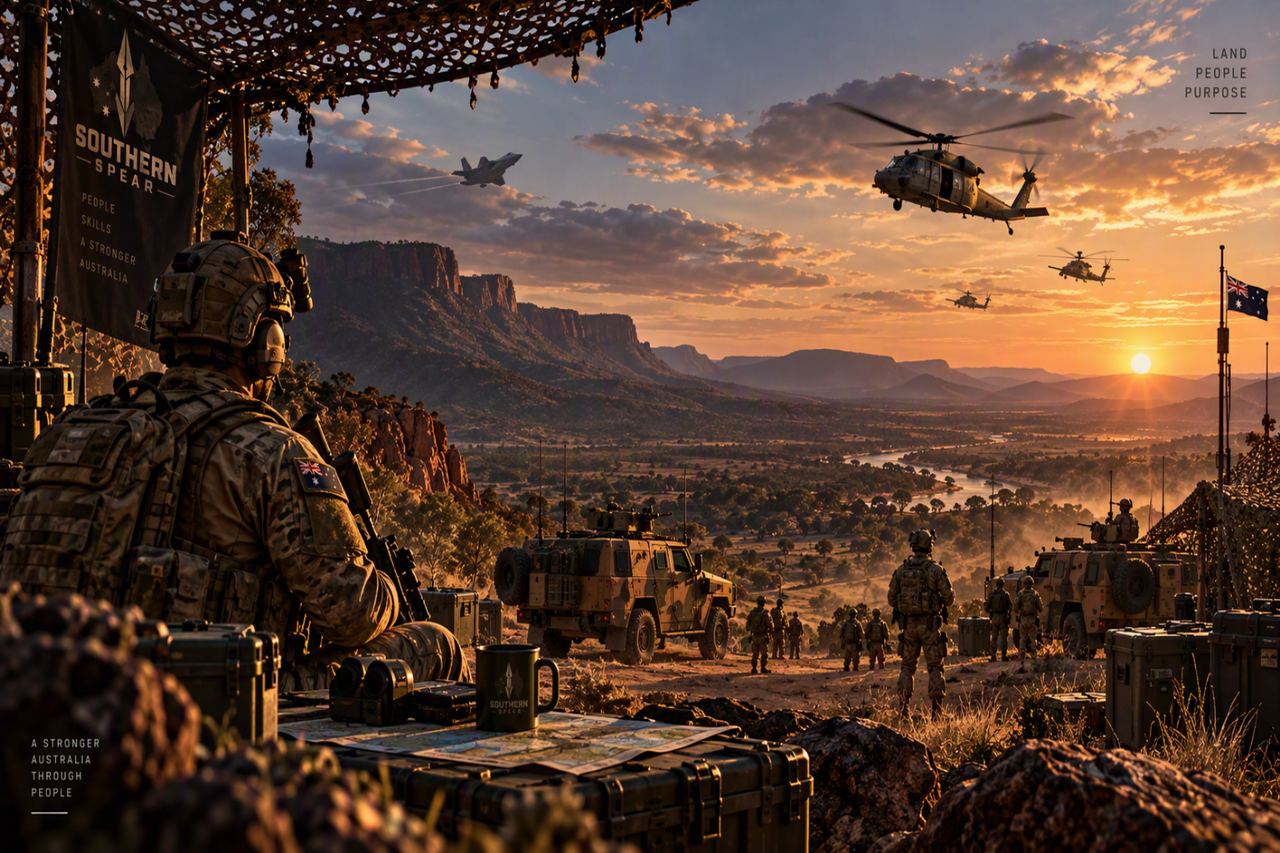
Title screen artwork Intended visual direction for the front end. The emblem and wordmark are approved brand assets; they are not a screenshot of a working interface.

Title screen and environment concepts

Only images marked In‑engine are captured from the game. Everything else in this section is title‑screen artwork or concept art produced outside the game, and is labelled as such.

Development

Where the project actually is

Everything below is read directly from the project’s own roadmap and changelog. Nothing is estimated or rounded for effect, and no completion percentage is shown because none is tracked. Southern Spear is pre‑alpha and is planned for Steam; no release date has been set.

Pre‑alpha. There is no playable build and no public download. Numbers below describe internal development progress only.

Loading development status…

Roadmap

Seven phases, one proven at a time

The project proves the expensive‑to‑get‑wrong parts first: networking, team presentation, authority and persistence. Art is deliberately deferred until the systems hold.

Loading roadmap…

Read the full roadmap document

Changelog

The latest session

Every working session is recorded with what was completed, how it was tested, the risks and the next action — evidence, not narrative. The newest entry is below; the full changelog carries every session, searchable and filtered.

Loading latest update…

Read every session, with search and category filters, on the changelog page. The log is also published as plain Markdown at data/CHANGELOG.md.

FAQ

Questions people actually ask

What is Southern Spear?

An original, free, community‑developed Australian‑inspired tactical multiplayer first‑person shooter, coming to Steam. It is built on Unreal Engine 5.8 using the Lyra Starter Game as its foundation, and is in pre‑alpha development.

Is the game playable?

No. There is no public build and no playable release. The editor target compiles cleanly and the project is developed in internal builds, but nothing has been released for others to play.

Is there a release date?

No release date has been announced. The project publishes its phases and session log instead, and has not committed to a schedule.

Is the project associated with the Australian Defence Force?

No. Southern Spear is a work of fiction. It is not endorsed, sponsored, developed or approved by the Australian Government, the Department of Defence, the Australian Defence Force or the Australian Army. All units and forces are fictional, and no map reproduces a real base, installation or operationally useful site.
Is it connected to America’s Army?

It is inspired by them, but it is not connected to them. Southern Spear takes its design philosophy from the classic America’s Army games — deliberate teamwork‑focused infantry combat, low time‑to‑kill, a limited HUD, radio discipline, and training that gates specialised roles.

Everything else is original. No source code, map layout, mission name, interface, audio, dialogue or artwork is copied or reused, and the project uses none of their marks, names or insignia. It is not affiliated with, endorsed by, sponsored by or approved by America’s Army or the United States Army, and any resemblance to official Australian or United States military material is coincidental.

Where will it be available?

Steam is the planned storefront. Development is pre‑alpha, so nothing is listed and no release date has been announced. Announcements will be posted on this site and in the Discord first.

What PC will I need?

Minimum and recommended specifications have not been measured yet, so none are published. They will be set by testing the game itself and listed on the Steam page. What is already fixed by the engine and the project’s own render settings:

Operating system
Windows, 64‑bit. Windows 11 is what Unreal Engine 5.8 is developed against.
Graphics API
DirectX 12 with Shader Model 6, the project’s default renderer.
Lighting
Lumen global illumination and reflections, with hardware ray tracing enabled. Cards without ray‑tracing hardware fall back to Lumen’s software path.
Shadows and scaling
Virtual shadow maps, and Temporal Super Resolution for upscaling and anti‑aliasing.
Performance target
60 fps at 1080p on the development reference card, a Radeon RX 9070 XT. That is the budget the build is held to, not a minimum.

In practice that points to a DirectX 12 graphics card with 8 GB or more of video memory, and an SSD, as is usual for Unreal Engine 5 games. Treat anything more precise as a guess until the numbers are measured.

Will the game be free?

The project is being developed as free to play, with no loot boxes and no pay‑to‑win mechanics. Donations are not currently being accepted.

Which engine does it use?

Unreal Engine 5.8, with the Lyra Starter Game vendored in as the multiplayer foundation. Unreal Engine is a trademark of Epic Games, Inc.

How can people follow development?

This website publishes the roadmap, the current status, and a session‑by‑session changelog generated from the project's own documents. The full log lives on its own changelog page, searchable and filtered. The website and its published documentation live in a public GitHub repository, and there is a Discord server for discussion.

Can people contribute?

Not at present. The game repository is private, and the game itself is not open source. The website and the documentation published alongside it are in a public repository.

Will there be community testing?

Community testing has not yet been announced or scheduled. The roadmap includes a phase for online hardening and load testing, and the Discord is where testing calls would be posted first.

Follow

Follow the build

There is nothing to download yet. The honest way to follow the project is to read the log and join the conversation.

Read the changelog

Every session, with test results, defects and the next action.

Open the changelog

Join the Discord

Talk to the team, follow development and hear about playtests when they open.

Join the Discord

Website source

This site and its published documentation are in a public repository.

View on GitHub

No public build

Southern Spear is pre‑alpha. There is no release to download. Donations are not being accepted. When a verified build exists, this page will state its version and date from the release metadata.